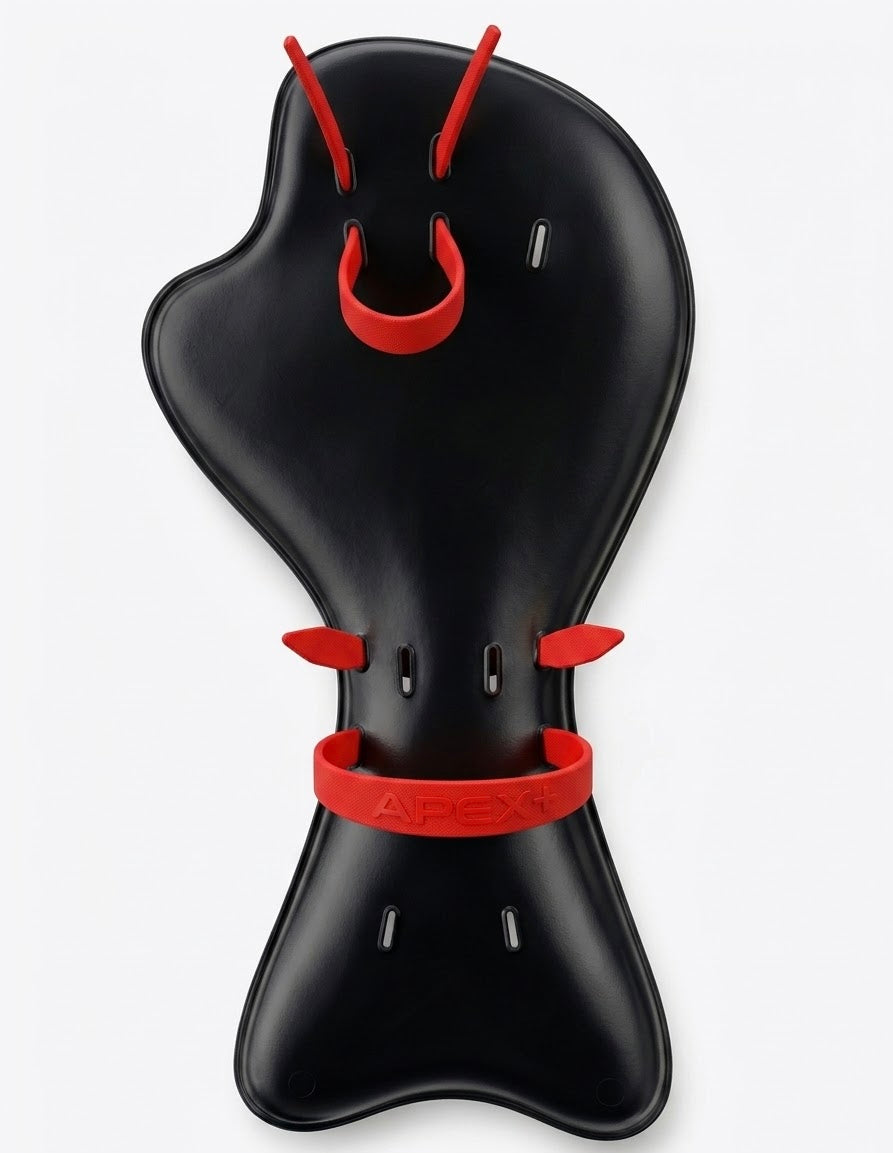
APEX+ EVF Anchor
The APEX+ EVF Anchor addresses one of the biggest challenges in swimming — engaging your back muscles for ultimate productivity and stroke efficiency.
A great design isn't just about aesthetics. It is a comprehensive understanding of the problem, and a relentless passion towards fixing it.
Each curve is not just good to look at, it has a purpose:
- Curves to make the paddle feel as one with your hand
- Curves to promote and amplify your distance per stroke
- Curves to reject your dropped elbow
And that is how we created the perfect tool to guide you to your full potential.
- 33% Off - celebrating the EVF Anchor launch.
- Free shipping across Egypt - limited time, no minimum order.
- Egyptian-made - engineered and manufactured in Cairo.
- Cash on Delivery — pay when your order arrives.
Measure from back of elbow to base of wrist, arm extended. Sold as an anatomical Left and Right pair.
Details
The APEX+ EVF Anchor is a forearm paddle built to make the high-elbow catch the only position that works. Drop the elbow and the Anchor loses water pressure instantly — physical feedback no verbal cue can replicate.
Why it works
A conventional paddle rewards whatever position holds the most surface area, which usually means the shoulder does the work. The Anchor's forearm-mounted design shifts the catch onto the lat instead — the correct chain, from the first stroke.
Two strap modes
Both straps secured for full-intensity sets from day one. Finger strap only for advanced swimmers raising the bar on positional discipline.
Sizing
Sized by hand length, tip of middle finger to wrist base. Medium: 15–19cm. Large: 20–25cm.
Egyptian-made. Engineered and manufactured in Cairo.
What traditional paddles get wrong.

Low Elbow Means Shoulder Loading, Not Power
When the elbow drops early in the catch, the shoulder becomes the primary mover. The latissimus dorsi, your largest pulling muscle, barely engages. You grind through the pull on the wrong muscle group, raising injury risk and sacrificing the power that lat-driven mechanics deliver.

Bigger Traditional Paddles Load Shoulders, Not Lats
Scaling up a conventional hand paddle does not improve catch mechanics. It amplifies shoulder load on a movement pattern that is already wrong. More surface area on a dropped-elbow pull means more drag and more strain, not better propulsion.
Instant Elbow-Drop Rejection
The Anchor loses water pressure the moment the elbow drops. The feedback is immediate and physical. The correct position becomes the only position that works.
Lateral Movement Suppression
Unconscious lateral movement in the catch path, and the balancing sculls swimmers add without noticing, are penalised by pressure loss. The Anchor trains a cleaner, more direct catch line.
Lat Engagement Over Shoulder Dominance
By enforcing the high-elbow position, the Anchor shifts the primary mover from shoulder to lat. More power through the correct chain, less strain on the joint.
Primary application. Trains directly into the freestyle catch cycle.
Optimal application. The EVF Anchor works perfectly for entry/catch phase, and ideal lats engagement through the pull/sweep phase.
Effective through the initial out-sweep, and works perfectly in the following lat-driven press/pull phase, requires more finesse through the recovery phase.
Useful for catch-phase drills. Full sets are harder to sustain due to stroke demands.
- Less control and finesse required
- Better utilisation across all four strokes
- Easier to hold technique at higher stroke rates
- Best for technique and drill work
- Greater lat engagement and resistance
- Power-oriented, effort-driven feedback
- Higher rejection of positional errors
- Best for strength sets and maximum lat loading
Both Straps Secured
RecommendedFinger loop and wrist strap both engaged. The paddle is stable and fully anchored to the forearm. Accessible from the first session and effective for sustained training at full intensity.
Finger Strap Only
AdvancedWrist strap released. The paddle is held only by the finger loop, so the correct forearm angle must be maintained to keep it engaged. Rejection of lateral movement and elbow drop increases sharply. Demands finesse and rewards refined catch mechanics.